
The FlexRICAN project reached its halfway point at the end of August 2025. This period proved crucial not only for the project timeline but also for the successful completion of several key deliverables and milestones.
One of these deliverables is the Global Plan for Potential Exploitable Results (GPPER). As indicated by its title, the GPPER focuses on the identification of Key Exploitable Results (KERs) emerging from the project and provides a tailored plan for their exploitation to ensure long-term impact and sustainability.
About FlexRICAN
FlexRICAN (Flexibility in RIs for global CArbon Neutrality) is an EU-funded initiative under the Horizon Europe programme. It aims to transform European Research Infrastructures (RIs) from passive energy consumers into active contributors to Europe’s clean energy transition.
The project addresses the challenge of the increasing energy demands and carbon footprints of RIs by developing and implementing integrated, tested, and transferable energy solutions. By turning major RIs into testbeds, FlexRICAN demonstrates how to enhance energy flexibility, integrate renewable energy, and improve efficiency, directly supporting the EU’s climate and energy goals.
The project encompasses:
- On-site renewable energy integration: deploying solar PV and hybrid systems.
- Energy flexibility: adapting RI operations through load shifting and flexible scheduling.
- Waste Heat Recovery: reusing heat from operational processes.
What is a Key Exploitable Result (KER)?
The Global Plan for Potential Exploitable Results (GPPER) outlines the potential exploitable results of the FlexRICAN project and serves as a strategic document to guide the dissemination, communication, and exploitation activities.
The initial meetings for GPPER were held before the 3rd Consortium Meeting in France, where the Exploitation Panel with the external experts took place and inspired further discussions regarding the identification of KERs and the tailored exploitation plan. The recording of the Exploitation Panel is available in our YouTube channel.
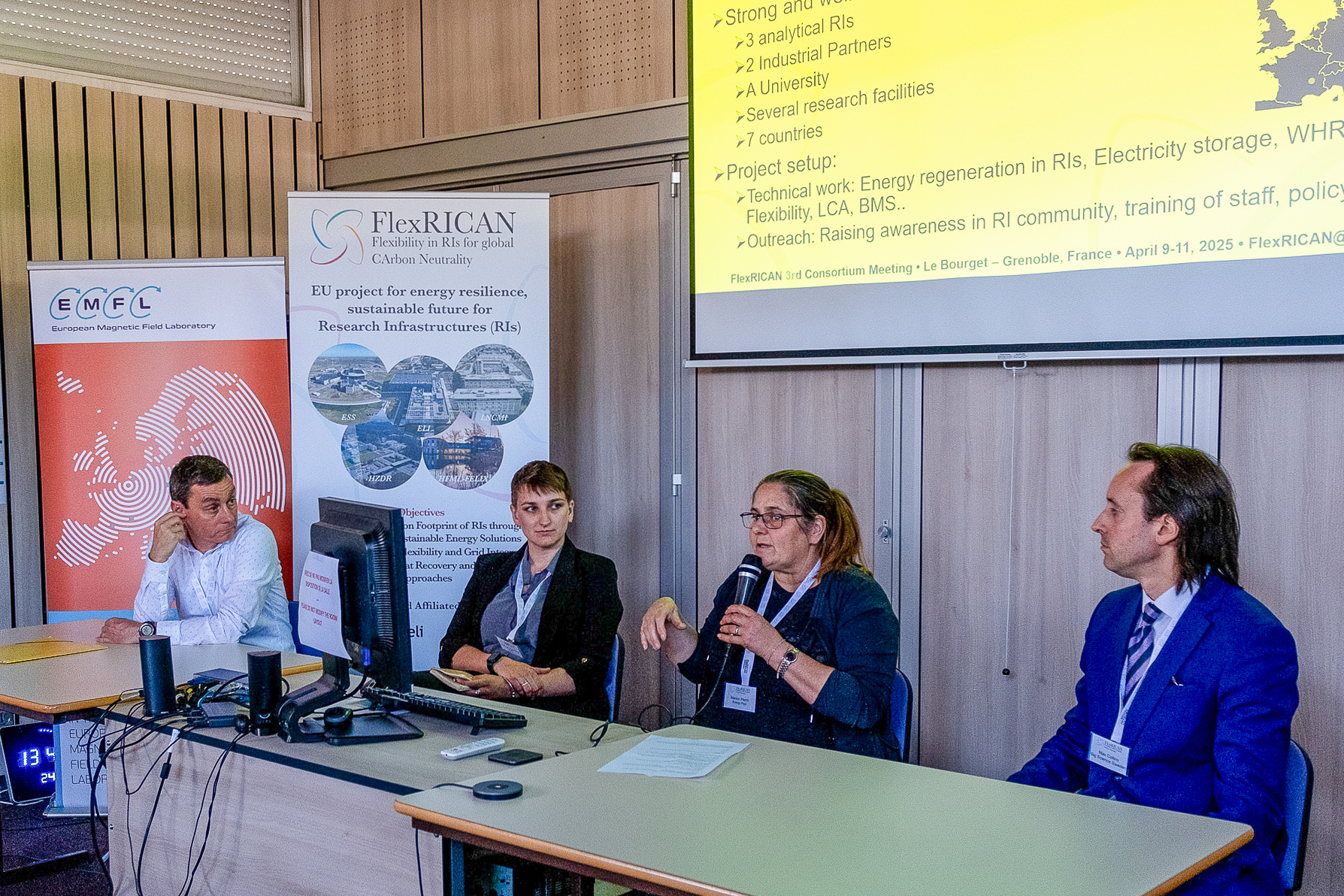
Adopting a bottom-up approach, all technical work package (WPs) leaders and participants identified and prioritised 9 KERs, ensuring impactful and realistic outcomes aligned with the project’s operational scope.
FlexRICAN KERs
KER#1: Software Tool for Predicting the Performance of a PV Plant at RIs
A Jupyter notebook to model and predict the performance of a solar installation, providing monthly and annual estimates for energy output. It provides the optimal configuration for an installation on RI site(s), comparison between the suggested vs. optimal configuration, total cost, payback time, return on investment, and LCOE, annual carbon savings and emissions, and carbon payback time. Users can input data manually, via the user’s own data files, or fetch data from online sources like PVGIS. The tool is meant to support the analysis process for designing and installing renewable energy generation systems at RIs.
KER#2: Software Tool for Optimising Energy Chain and Battery Storage Planning
An online tool and an associated webpage focusing on the optimal technology chain for integrating large-capacity batteries and electrical power modulation equipment. It presents a schematic for connecting devices in a sequence designed to mitigate power quality issues while simultaneously reducing costs and emissions based on user inputs. The webpage includes insights derived from questionnaires and research, practical usage examples, and a comprehensive guide on how to effectively utilise the tool.
KER#3: High-Temperature Klystron Cooling Report
A final report on recommendations on how to increase the waste heat grade from klystrons. The work investigates parameters and approaches (e.g. cooling water flow rate, cooling water inlet temperature, exchange surface enhancement, P&ID configurations) to increase the temperature of the cooling water exiting the klystron’s collector without affecting performance or considerably reducing lifetime. The results provide a guideline for the possibility of increasing waste heat grade in similar devices and infrastructures and can benefit a wide range of industries and RIs dealing with waste heat recovery generated through cooling equipment.
KER#4: Waste Heat Valorisation Report
A report specifying the implementation of a system which uses low-temperature waste heat in the most efficient way. The work develops a proposal to produce 25°C–30°C warm water from high-field magnets and to check the global energy efficiency of these temperature set points when waste heat is provided to a local heating network and/or stored for later use. Depending on results, heat exchangers, heat pumps to upgrade the temperature to 50°C, or valves could be installed to prepare or optimise the connection to local heating networks.
KER#5: Open-Source Data Repository of Program Blocks for Intelligent Building Management Systems
Open program control blocks tailored for essential building technologies such as HVAC units, pumps, valves, dampers, and more, addressing requirements of RIs with conventional and specialised cleanroom environments. The tool generates program code tailored for RIs, resulting in reduced operational costs and emissions and more stable indoor conditions, allowing for straightforward and intuitive modifications and enabling a transition from a proprietary “black box” BMS to an open system.
KER#6: Cleanroom-oriented Technological Chain Optimisation Tool
An online tool and associated webpage that assesses the feasibility of dehumidification based on the user’s specified location and offers a schematic for connecting devices in a sequence aimed at reducing operational costs and emissions, while complying with user-defined parameters. It supports evidence-based recommendations on the ideal locations for new facilities and identifies the most effective technological combination of components to ensure optimal indoor climatic conditions.
KER#7: Analysis Tools and Methodology to Optimise Energy Management for Flexibility and Sustainability
An open-source Python-based tool, including its graphical user interface, specifically optimised for RI needs. It analyses and optimises the energy flow (production, storage, usage, regulation) at RIs with optimisation parameters including ecological footprint (CO2 emission), network stability and economic considerations. Starting from validated use cases, facility managers at other RIs can adapt for their specific facility needs and obtain conclusive and specific results for stakeholders and decision makers.
KER#8: Report on Flexibility Quality Label Initiatives
A report summarising the input provided to the AFNOR process for an energy flexibility report in a standardised format. The report covers both the content itself as well as the ways of working to converge on such a “quality label”, with two parts (what and how information is provided), complemented by an executive summary and lessons learned. It is targeted for policy makers as well as suppliers and actors for the (electrical and heat) grid.
KER#9: Report on Current and Future Usage of Helium – Sustainability and Costs
A report that puts the “helium-free” topic into a much wider perspective, going beyond energy analysis towards the complete environmental impact. It includes an analysis of CNRS high field laboratory infrastructures and considers “green helium” (without considering it as a side product of natural gas production), as well as the impact of losses. The report is targeted for RI senior management, policy makers, and helium suppliers, to raise awareness with RI stakeholders and the public.
To ensure the effective uptake of FlexRICAN’s outcomes, the KERs will be exploited accordingly with their specific types listed below:
- Software Tools and Methodologies (KER#1, #2, #5, #6, and #7) will be released under permissive open-source licenses on public platforms like GitHub, supported by clear documentation and video tutorials to ensure a smooth introduction to the tools.
- Reports and Knowledge-Based Outcomes (KER#3, #4, #8, and #9) will be exploited through public archiving in open-access repositories like Zenodo and the distribution of targeted, one-page executive summaries to specific stakeholders such as facility managers, policy makers, and industry associations.
These efforts are further amplified through participation in international conferences, the hosting of specific exploitation panels with external experts, and the organisation of training sessions to ensure the results are integrated into future best practices and research.
Together, these nine Key Exploitable Results support FlexRICAN’s goal to enhance energy flexibility, integrate renewable energy, and improve efficiency in RIs. The software tools and methodologies enable planning, optimisation, digitalisation and smart control, and scenario analysis for energy management. The reports provide guidelines, design proposals, and standardised input and lessons learned for waste heat recovery, district energy & resilience, and sustainability and costs. As actionable outputs designed to be scaled and adopted across the wider RI ecosystem, the KERs support the project’s operational scope and contribute to Europe’s clean energy transition.